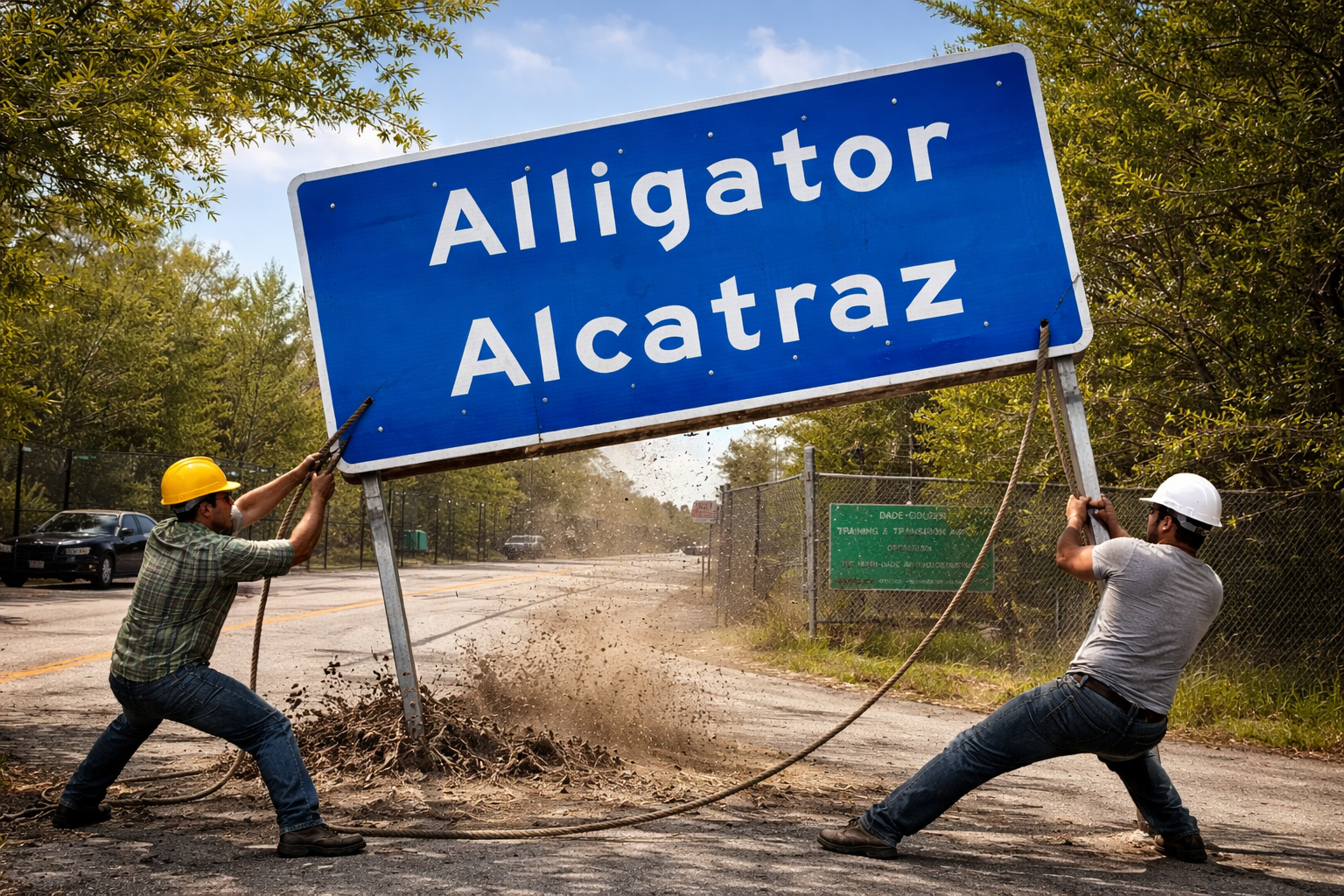
Oh happy day! Imagining the Alligator Alcatraz sign being removed. (Illustration: AI for Silverberg4Florida/ChatGPT)
April 9, 2026 by David Silverberg, candidate for Florida Senate, District 28
The issue, more than any other, that moved me to run for the Florida Senate sits directly in the district I am running to represent.
It is named Alligator Alcatraz. Make no mistake: it is a concentration camp.
It is a concentration camp because it concentrates detainees and inmates in a single location, whether for processing, deportation, punishment or incarceration. No one can be sure what’s happening there because outside observers cannot get in. American citizens—even as young as 15 years old—have been detained there without due process, a hearing or a chance to establish their innocence.
There have been reports of cruel and unusual conditions and appalling treatment that doesn’t meet basic American standards of justice or incarceration.
As if the injustice, indignity and injury of Alligator Alcatraz were insufficient, the monstrosity in the swamp has already cost the state of Florida over $600 million in taxpayer dollars, which the governor and his accomplices do not know if they can get back from the federal government.
Even if the state gets reimbursed for its past expenses, Alligator Alcatraz is costing Floridians a million dollars a day to operate. That’s money coming straight out of our pockets at a time when we’re struggling to put food on the table and gas in the tank.
As if that wasn’t bad enough, the money being spent on Alligator Alcatraz is coming from funds designated for emergency management—responding to and cleaning up disasters like hurricanes. This state money is now extremely important because the Federal Emergency Management Agency (FEMA) has been gutted for funding and personnel. Donald Trump wants the states to handle emergency response and even wants to do away with FEMA.
Given that, there’s no telling if there will be federal funding help us if the worst happens this hurricane season in Southwest Florida. So every cent needs to be reserved for state emergencies—not thrown away in a swamp.
Nor are the direct costs of this concentration camp the only concern; there are also the ancillary costs of defending it in court from its many legal challenges.
Additionally, there is no telling how much money went to contractors in sweetheart, no-bid deals and grotesque overcharges—like $92 million for porta-potties—and continue to go there.
Alligator Alcatraz was hastily constructed without the consultation or consent of the people of Florida. It is the brainchild of Florida Attorney General James Uthmeier, who promoted and took credit for it. It was created without any regard to its impact on the sensitive environment of the Everglades or its effect on the people of the Miccosukee Tribe of Indians whose lands are adjacent to it.
The history of concentration camps is not reassuring: if not closed, Alligator Alcatraz is likely to go from a temporary facility to a permanent installation, and its capacity will likely expand. It will devolve from holding migrants with criminal records, to imprisoning innocent immigrants, to jailing US citizens, then dissidents, then political opponents, then factions in the ruling regime. And its mission will transition from detention to incarceration to death.

A dangerous progression: A patch worn by guards at Alligator Alcatraz bears an ominous similarity to a Nazi SS ‘Totenkopf’ insignia from World War II. (Photo: Miami Herald and historic archives)
What is more, Alligator Alcatraz is the first concentration camp in a string of concentration camps that the Trump administration is building to create an American gulag on the Soviet model. There’s Deportation Depot in north Florida, the Lonestar Lockup in Texas, the Speedway Slammer in Indiana and the Cornhusker Clink in Nebraska. On top of these are warehouses being obtained by the Immigration and Customs Enforcement (ICE) directorate of the Department of Homeland Security to hold the people it purges in cruel and unusual conditions.
Alligator Alcatraz is not making Americans safer. If it were really just for rounding up criminal aliens then its mission would be fulfilled by now and it would be dismantled.
Instead, Alligator Alcatraz and the gulag system of which it is a part is a clear and present danger to all Americans, regardless of citizenship status. It threatens all Americans all the time and is an attack on our freedom and fundamental rights.
There is the possibility that if Donald Trump tries to overturn the results of the 2026 midterm elections and Americans protest in large numbers, they will be rounded up and held in this American gulag.
If elected, the very first bill I will introduce to the Florida Senate will close Alligator Alcatraz.
Nor do I want Alligator Alcatraz merely closed—I want it scraped from the face of the earth and replaced with a restored Everglades environment.
There is the possibility that Alligator Alcatraz might be closed by court order. This already happened once but it made no difference as the state appealed the ruling. There’s no telling how long the court process is going to take to resolve these issues.
If elected, I’ll not only introduce legislation to close it, I intend to investigate the contracting waste, fraud and abuse that went into its building and operation. I will work to claw back any ill-gotten gains and return them to taxpayers and hold guilty parties to account.
To his great credit, Democratic gubernatorial candidate David Jolly has just committed to closing Alligator Alcatraz if he’s elected governor. I applaud that position and endorse it. If Jolly wins his race and I win mine, I will do all I can in the Florida Senate to assist and support his efforts to close this camp.
As Alligator Alcatraz was the first concentration camp in a would-be Trump gulag, so it should be the first to be removed. Its termination will lift a dangerous threat to every American, whether native-born or immigrant.
Alligator Alcatraz is a moral stain, a financial drain—and it cannot remain.
See Silverberg4Florida.com for more positions and opportunities to volunteer.
To donate to the campaign, please click here.
© 2026 by David Silverberg