
Floridians face a fork in the road in the year ahead in this artificial intelligence-generated illustration. (Art: AI for TPP/ChatGPT)
Jan. 5, 2026 by David Silverberg
This year Florida voters will face choices that will determine how they live their lives as well as the direction and destiny of their state—even more so than in “normal” election years.
At the top of the list will be the race for governor.
Then there is election of a senator. The current senator, Sen. Ashley Moody (R-Fla.), is running in her own right after being appointed in January by Gov. Ron DeSantis (R) to fill in the unexpired term of Marco Rubio, who was appointed Secretary of State.
The race for Chief Financial Officer will be unusually important and competitive this year as well and the race for Attorney General will see the incumbent, James Uthmeier, creator of the Alligator Alcatraz concentration camp, defending his seat.
On the same ballot will be elections for offices at all levels including members of the House of Representatives but also state, county and municipal offices. Because President Donald Trump will be on the road stumping for his candidates, Floridians should expect some Trump rallies to boost their chances.
In the legislature two major issues will dominate the session that begins Jan. 13, or possibly a special session: whether to redistrict Florida in mid-decade and whether to abolish property taxes.
Beyond these political occurrences, Florida is scheduled to host two major scheduled events this year: Miami will be one of 11 American cities hosting Fédération Internationale de Football Association (FIFA) World Cup games.
In December, Miami will again be the host city for the G20 summit of the world’s leading economic powers at the Trump National Doral Miami resort and spa.
(For a fuller discussion of these events, see The year ahead: Keeping the light alive).
The governor’s race
Gov. Ron DeSantis (R) is term-limited and so his seat is up for grabs.
Media coverage of the race conveys the impression that only three Republicans and two Democrats are seeking their parties’ nomination.
In fact, as of Jan. 3 there were 11 Republicans, 9 Democrats and 14 non-party, independent, other party and write-in candidates running for Governor, according to the Florida Department of State.

Declared candidates for governor, as of Jan. 3, 2026. (Chart: TPP from FDoS)
The ultimate filing deadline is noon, June 12, 2026, so this list can be expected to get perhaps a bit shorter as candidates drop out—but more likely a lot longer.
It’s in this kind of situation that a free and independent media should play its democratic role in winnowing the field to what are generally considered the “serious” candidates.
On the Republican side, the leading candidate is Rep. Byron Donalds (R-19-Fla.), who was endorsed by President Donald Trump even before he declared his candidacy in February. Donalds has also been endorsed by businessman Elon Musk, other large donors and a slew of Republican officeholders in the state and has a reported war chest of $40 million. However, this includes contributions to his congressional campaign, which the Federal Election Commission ruled must be refunded to donors, a dispute that was unresolved as of this writing.
Two other credible Republican candidates are former Florida House Speaker Paul Renner, and businessman James Fishback.
Hovering in the wings are Lt. Gov. Jay Collins (R) and Florida First Lady Casey DeSantis, who was long considered a possible contender. By the end of the past year she had not definitively stated her status one way or another, although a run seemed doubtful, and Collins had not declared his candidacy, despite much media speculation.
On the Democratic side the leading contender is David Jolly, a former congressman and converted Republican who has been actively campaigning throughout the state. To the degree that he has any serious challenger within the Party, it comes from Jerry Demings, the Orange County mayor and former sheriff.
(Editor’s note: The most notable candidate in the running, based entirely on name alone, is Republican Shea Cruel. A Cruel versus Jolly race would generate headlines for the ages.)
Two big issues hovering over the gubernatorial race are the degree to which the new governor will continue DeSantis’ culture war against “woke” and policies—particularly against immigration and migrants—and the new governor’s relations with Trump if Trump is in office during the governor’s full tenure.
Despite the seriousness of these issues, the contest on the Republican side has already turned nasty and personal and can expected to become more so as Primary Election Day, Aug. 18, approaches. Candidates clearly see the race turning on personal factors and there is no indication this will change as the year progresses.
(The Paradise Progressive will be covering the gubernatorial race and candidates in much more detail in days to come.)
The Senate race
Sen. Ashley Moody (R-Fla.) will be defending her seat this year. Serving as the state attorney general, she was appointed senator by DeSantis in January when sitting senator Marco Rubio was named Secretary of State. In this election Moody will be seeking the office in her own right.
There are already a slew of candidates both on the Republican primary side and among Democrats and independents.
An early Democratic opponent, Joshua Weil, who made a name for himself as a very effective fundraiser in a special congressional election, dropped out of the race in July due to medical conditions. Alexander Vindman, a resident of Broward County and retired US Army colonel whose whistleblowing on Trump’s phone call leading to his first impeachment, has also fueled speculation about a Democratic run for the seat.
However, Moody as the incumbent has the clear advantage in name recognition, funding and endorsements. She won attorney general seats twice in statewide races in 2018 and 2022, although without serious opposition.
However, the unexpected always lurks around the corner.

Candidates for Florida’s Senate seat as of Jan. 3. (Chart: TPP from FDoS)
The Chief Financial Officer race
The state of Florida created the office of Chief Financial Officer (CFO) in 2002, consolidating several finance-related positions into a single Office of Financial Regulation.
This is an elected, Cabinet-level position that is third in line to succeed the governor after the lieutenant governor. There have been four CFOs since its creation, three Republicans, one Democrat as well as a brief acting CFO.
Blaise Ingoglia (R) is the fifth CFO, appointed in July 2025 when the previous one, James “Jimmy” Patronis, stepped down to run for a congressional seat in a special election in the 1st Congressional District to replace the resigning Matt Gaetz.
This year Ingoglia is running to fill a full, four-year term in his own right.
Ingoglia served as a state senator from the 11th District, which covered the largely rural Citrus, Hernando, and Sumter counties and part of Pasco County. Before that he served as a member of the state House of Representatives.
Ingoglia, originally from Queens, NY, moved to Spring Hill, Fla., in 1996 where he worked in real estate and then entered politics in 2008.
Ingoglia has been a consistently extremely conservative politician, often pushing the most radical ideas on issues like immigration enforcement, voting accessibility and taxation.
While there are 6 candidates running for the office, the most credible other candidate is state Sen. Joe Gruters (R-22-Sarasota) who is currently also serving as chairman of the Republican National Committee (RNC). He was also former treasurer of the RNC and served as chair of the Florida Republican Party from 2019 to 2023.
Gruters received Trump’s “complete and total” endorsement for CFO in 2024 and is promoting himself as the true America First, Make America Great Again (MAGA) believer, in contrast, he says, to Ingoglia. At the same time DeSantis attacked Gruters as insufficiently conservative.
There is only one non-Republican candidate for the office, John Smith, an Orlando businessman with a hurricane storm shutter business, who is running as non-party affiliated. As of Jan. 3 there were no Democratic Party candidates.
Smith’s candidacy closes the Republican primary to non-Republicans, effectively disenfranchising Democratic voters unless a Democratic candidate appears before the deadline. In this he is effectively functioning as what is known as a “ghost” candidate.
Unless the field changes, this will be a cramped, internecine Republican Party battle based on the fervor of the various candidates’ belief, the purity of their extremism and the ability to appeal to a hardcore MAGA base. It will likely be decided in the August 18 primary.
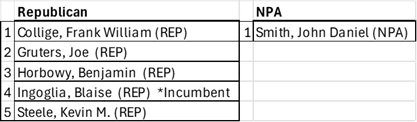
Candidates for the position of Florida CFO as of Jan. 3. (Chart: TPP from FDoS)
Attorney General
This year James Uthmeier (R) will be defending his seat as Florida Attorney General against a Republican challenger and two Democratic Party candidates.
Uthmeier, 38, was appointed in February 2025 to take the place of Ashley Moody when she was made senator by DeSantis. Prior to that he served as the governor’s chief of staff.
In his short time as Attorney General, Uthmeier has proven an aggressive, heavily ideological and outspoken partisan.
Uthmeier’s most notable action since taking office was the founding—and apparent naming—of the Alligator Alcatraz concentration camp in Collier County. He announced its establishment, heavily promoted it and has vigorously defended it against the lawsuits and challenges.
Uthmeier has also been prominent for other reasons. During the COVID pandemic he opposed masking and vaccine mandates. As attorney general he was held in contempt for violating a judge’s order staying enforcement of Florida’s anti-migrant law, attacked all forms of diversity, equity and inclusion, threatened local governments and officials who showed insufficient zeal for immigration detention efforts, worked hard to undermine local government autonomy, supported Trump’s midterm gerrymandering effort and launched investigations into bio-engineered meat and non-profit organizations collecting climate data—while refusing to defend Florida’s law against gun sales to minors.
Uthmeier’s Republican opponent is Steven Leskovich, a trial attorney who has lived in Florida for 30 years and states that he’s running to defend the Constitution, eliminate corruption, fight crime, “and political weaponization in the justice system.”
There are two Democratic candidates.
Jim Lewis is a political aspirant who previously ran unsuccessfully for the Democratic attorney general nomination in 2022 and mayor of Fort Lauderdale in 2023 as well as a variety of other state and county offices.
Jose Javier Rodriguez served in the Florida House and Senate and was Assistant Secretary of Labor for Employment and Training from April 2024 to the end of President Joe Biden’s term in office.

Candidates for the position of Florida Attorney General as of Jan. 3. (Chart: TPP from FDoS)
Commissioner of Agriculture
While the Florida Commissioner of Agriculture has broad responsibilities and authorities to support and regulate the state’s agriculture, consumer protection and environment, the office is usually a non-controversial one. However, as a Cabinet position it has also proved a platform for aspiring statewide candidates.
In 2018 Nicole “Nikki” Fried won the seat, the only Democratic Party candidate to attain statewide office that year. After leaving office in 2023 she became chair of the Florida Democratic Party. In 2018 Adam Putnam was the leading contender for the Republican gubernatorial nomination until Trump endorsed DeSantis.
This year, as of Jan. 3 there were three candidates for Agriculture Commissioner: Republican Matthew Taylor, Democrat Chase “Andy” Romagno and non-party affiliated Kyle Gibson, who is currently seeking petition signatures to run for governor, rather than commissioner.

Candidates for the position of Florida Agriculture Commissioner as of Jan. 3. (Chart: TPP from FDoS)
Midterms and The Big Rig
Florida appears on the brink of joining Trump’s effort to gerrymander congressional districts nationwide in order to determine the election’s outcome in his favor. Given his use of the word “rig,” “rigged” and “rigging” to denote manipulation of a process, it seems only appropriate to dub his gerrymandering project “The Big Rig.”
It is very difficult to say how the rigging process will play out in Florida. At the end of the year, as the legislature began its early committee hearings, DeSantis and House Speaker Rep. Daniel Perez (R-116-Miami) were both pushing for it. However, DeSantis was floating the idea of a special session while Perez wanted to get it done by the end of the regular session on March 13. By contrast, Senate President Sen. Ben Albritton (R-27-Bartow) was more cautious and in agreement with DeSantis.
Regardless of the timing, there seems agreement to rig Florida’s districts among the legislature’s Republican supermajority. Democrats, as to be expected, are opposed and are backed by grassroots opponents. However, when the House held its first procedural committee hearing on redistricting, the public was shut out and no comments from the floor were allowed—no doubt a preview of what is likely to be a forced, arbitrary and undemocratic effort by lawmakers.
As The Big Rig moved bumpily forward in other states it increasingly looked like Florida could be the last but most decisive Republican state to gerrymander its districts. But even with lawmakers’ likely enthusiasm for the idea, it faces a buzzsaw of legal, political and opposition hurdles. Opponents were encouraged by Indiana’s refusal to bend to Trump’s threats, insults and demands and will likely attempt a repeat in Florida.
If Florida does rig its congressional map, every federal representative and challenger will be affected. Even if Republicans pick up some additional ostensibly Republican districts, that may not matter as much as it would in previously “normal” elections. There is also virtually no doubt that any new map will be challenged in court.
However it ultimately turns out, the battle is already introducing a new level of tumult and turmoil in this year’s already roiled Florida political scene.
Affordability and the property tax debate
Life for everyday Americans is getting more expensive and difficult. The only person who seems to disagree with this assessment is President Donald Trump, who has dismissed discussion of affordability as “a Democratic hoax.”
Florida Democrats, like their counterparts across the country, recognize voters’ stress and are making affordability key plank in their 2026 platform.
“Prices are rising, period. And we are seeing Republican politicians pander to DC and squabble amongst themselves instead of fixing the problem, so Democrats are offering ideas,” Florida House Democratic Leader Rep. Fentrice Driskell (D-67-Temple Terrace) told a press conference on Dec. 8.
The Democrats are already offering legislation to make inroads on high costs but as a minority in a supermajority Republican legislature, the road to passage is steep and the odds are long.
In Florida the affordability crisis is especially acute and the result of a variety of factors like the high proportion of seniors on fixed incomes.
But playing a major role are natural factors like prevalent and frequent disasters like hurricanes, which drive up insurance costs while at the same time making insurers flee the state. Furthermore, climate change is driving up the risks to the state’s residents while the Republican-dominated state government determinedly denies its existence. That in turn dampens efforts to build climatic resilience, increasing the state’s vulnerability to disasters, which in turn drives up costs and insurance rates, in a vicious cycle.
Another factor is human and ideology-driven: The DeSantis administration and the Republican state legislature, in synch with the Trump regime, has waged war against migrants, immigrants and foreigners of all kinds. Not only has every county and jurisdiction in Florida been pressured into working with the Immigration and Customs Enforcement (ICE) directorate of the US Department of Homeland Security to deport undocumented migrants, the Florida legislature has passed some of the harshest anti-migrant legislation in the country.
This has had the practical effect of devastating Florida’s low-cost labor pool, which previously provided migrant and immigrant labor, particularly in the construction, hospitality, tourism and agricultural sectors. That in turn has driven up the costs of goods and services as labor becomes scarcer and more expensive, the cost of which is passed on to consumers.
(Additionally, Trump’s threats to Canada and his enmity to visiting foreigners has dampened a once-robust tourism industry important to Florida’s economy.)
To compensate for the workforce losses, the Florida legislature has entertained the idea of lowering the barriers to underage labor (introduced by current Lt. Gov. Jay Collins (R) when he served in the Florida House), and allowing minors to work longer hours, for lower wages in more hazardous and demanding jobs.
That their own policies might be exacerbating the affordability crisis for Floridians is not an admissible notion for the Florida Republicans in power, so they must seek some relief in a different remedy.
Taxation has never been popular in Florida and now DeSantis wants to take anti-taxation to a new level and abolish property taxes altogether.
Florida is already a low-tax state. It has no income tax, estate or inheritance taxes. Its tax collection is very low per capita. Most importantly, it features a homestead exemption that reduces the assessed, taxable value of a lived-in home and limits annual property tax increases.
DeSantis floated the idea of ending property taxes in his annual State of the State address on March 4, 2025.
“While Florida property values have surged in recent years, this has come at a cost to taxpayers squeezed by increasing local government property taxes,” he said. “Escalating assessments have created a gusher of revenue for local governments—and many in Florida have seen their budgets increase far beyond the growth in population. Taxpayers need relief. You buy a home, pay off a mortgage—and yet you still have to write a check to the government every year just to live on your own property? Is the property yours or are you just renting from the government?”
Since then the debate over the future of property taxes in Florida has been percolating at a relatively low level but this year when the legislature convenes on Jan. 13 it will be coming to a full boil.
Local governments depend on property taxes to provide basic services, income for schools and infrastructure maintenance and improvement—and the revenue has hardly been a “gusher.” Experts and local officials have been making the case that an end of property taxes would cripple their operations.
“Local governments would lose fiscal autonomy as they would no longer collect property taxes, and they would become dependent on the state for funding (whether it is for schools or other public services like police and fire services),” warned the Florida Policy Institute in an in-depth paper, “A Risky Proposition: Weakening Local Governments by Eliminating Property Tax Revenue,” issued in February.
At the same time CFO Ingoglia has been prowling the state in imitation of Elon Musk and the now-abolished Department of Government Efficiency (locally renamed FAFO, which has a profane generic meaning but in this case stands for the Florida Agency for Fiscal Oversight).
Ingoglia was trying to highlight what he said was wasteful spending by local governments but they pushed back.
“This whole thing is a made-for-television event, and it’s specifically made for television for the CFO’s re-election,” said Seminole County Commissioner Lee Constantine (R-District 3) at a forum in November. At the same event Broward County Democratic Commissioner Steven Geller (D-District 5) was similarly scornful. “Check the numbers,” he said of Ingoglia’s audit of his county. “Because they are fictitious. Made-up. Phony. False.”
In addition to its impact on local governments, experts are warning that abolishing property taxes would have to be made up with sales taxes that fall most heavily on the least wealthy Floridians, the working and middle classes, while benefiting the rich. Florida is already the most “regressive” tax state in the nation and ending property taxes would make the burden even more extreme.
Realtors have also warned that ending property taxes would drive up home prices by 9 percent, repelling new home buyers and renters from the market.
These are thorny, difficult and ultimately increasingly emotional issues that will likely dominate the legislative session and all of 2026.
Two paths diverged
The year’s elections will take place amidst an increasingly fragmented Republican legislative majority.
The days of automatic obedience to DeSantis when he was running for president are over. State Republicans, especially House Speaker Perez, are proving contrarian and intractable—or skeptical and independent, depending on one’s point of view.
This is in no way implies a repudiation of Trumpism. In fact, during the 2025 session the battle between DeSantis and Perez was over who was more passionate and committed in the service of Trump’s hatred of migrants and immigrants. DeSantis viewed the proposals by Perez and the legislature as too weak and when the legislature passed its own TRUMP (Tackling and Reforming Unlawful Migration Policy) Act, (CS/SB 2B), DeSantis vetoed it.
While the rest of the country may be revolting against Trump’s threats and bullying, in Florida legislative pushback against an equally bullying and autocratic state government remains relatively tepid and weak.
Ultimately, the fissures and faults in Florida’s governance will have to be resolved by the primary and general elections this year.
It’s as though Floridians stand at a crossroads: one path leads into sunshine and a brighter future, the other into a dark, watery swamp—and as every Floridian knows, where there’s water, there may be alligators.
When you live in Florida, you have to pick your steps with care, whether in the streets, by the streams—or in the voting booth.

Liberty lives in light
© 2026 by David Silverberg