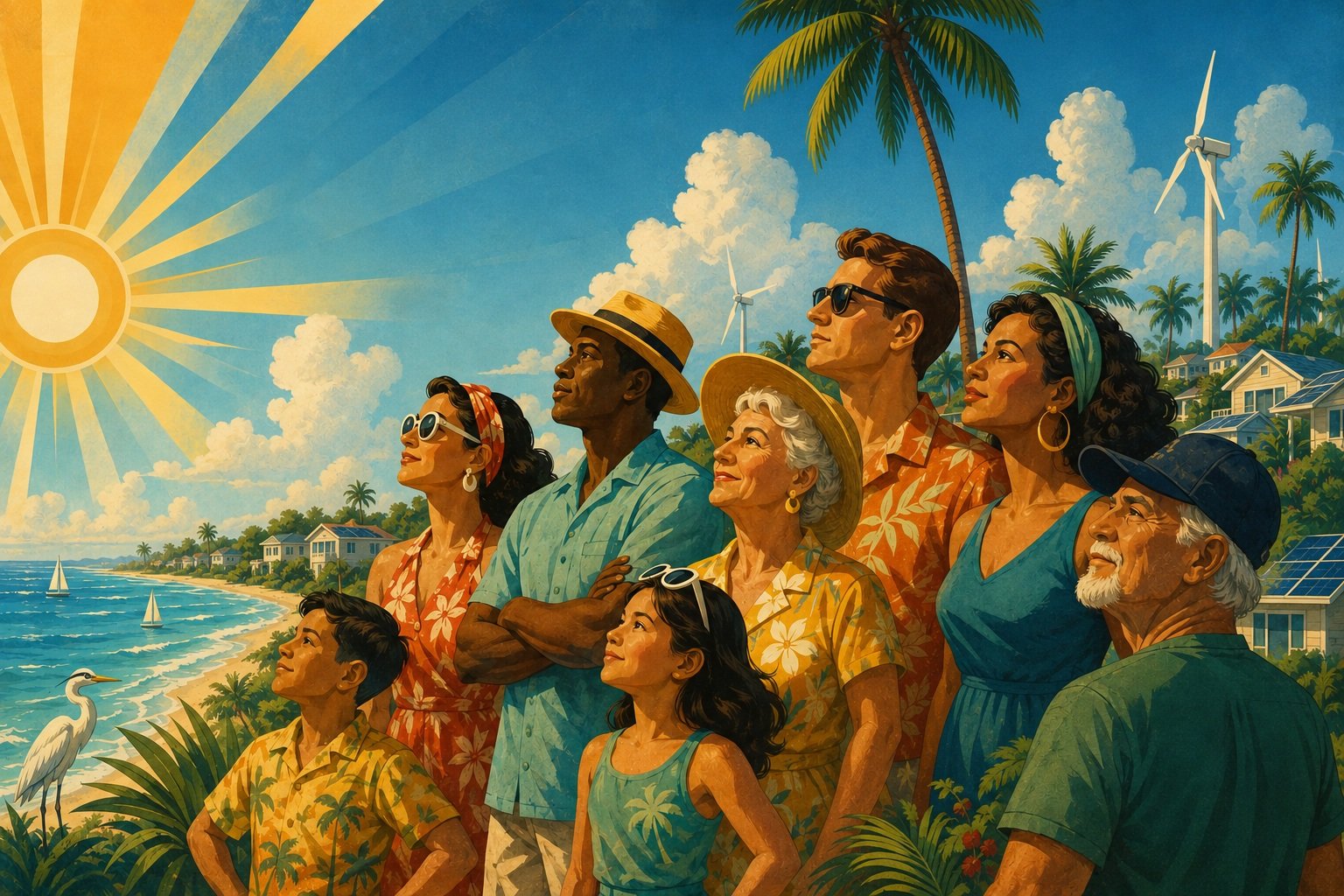
Even with the onset of hurricane season, Floridians should be able to face their sun and skies with hope and confidence. (Art: AI for TPP/ChatGPT)
June 1, 2026 by David Silverberg, candidate for Florida Senate, District 28
June 1st is a special date for me personally. It marks the date in 2013 that I became a full-time resident of Florida. Very appropriately, it also marks the start of hurricane season.
Long-time residents of Southwest Florida, and particularly Senate District 28—Collier, Hendry and eastern Lee County—know the hurricane drill: have plenty of batteries, bottled water and supplies sufficient for two days without electricity or assistance, although preferably for seven days. Make a plan if the worst happens. Know your evacuation zone and the routes out of town.
Every sitting politician with even a sliver of sense posts these suggestions on his or her website or Facebook page. It’s standard practice. Usually, at that point they wash their hands of the topic.
But here’s an idea: What if we actually gave some thought to the impact of hurricanes and other potential disasters? What if we actually worked to prepare our districts and the state for the ravages of natural calamities? What if we actually did something to help and protect the people and the state?
And here’s a really big idea: What if we acknowledged that we are in the midst of climate change and came up with ways to respond to it?
You read that right: climate change. Florida’s forbidden words!
Not only will I acknowledge it but I’ll state it again: Climate change! Climate change! Climate change!
We’re in it. It’s happening. We have to face it.
My name is David Silverberg and I’m running for the Florida state Senate in District 28; Collier, Hendry and eastern Lee County. Not only will I acknowledge that climate change is real but if elected I intend to prepare this district and state for the impacts and I’ll do what I can to reduce its effects.
The level of climate change denial by the governor, the legislature and all sitting politicians—what I call “Big Tallahassee”—is extraordinary. None will acknowledge it. Sen. Rick Scott, when he was governor from 2011 to 2019, imposed an informal ban on use of the term in state government. (You can see a hysterically funny video of a Florida official struggling not to utter the words “climate change” during a legislative hearing, here.)
Then, in 2024 the legislature passed, and Gov. Ron DeSantis signed, a law banning use of the term in all state laws.
That’s like passing a law stating that the sun revolves around the earth, or revoking the law of gravity. You can get it through the legislature but that doesn’t necessarily make it true in the real world.
The willful avoidance is extraordinary. (For a detailed discussion see my essay: “Denial, delusion and disaster: Ron DeSantis and Florida’s climate change.”)
But this head-in-the-sand attitude isn’t confined to just Tallahassee, it’s national and it starts at the very top. In 2024 the notorious Project 2025, the blueprint for the current presidential administration, stated that it wanted to dismantle what it called the “climate change alarm industry.”
To do this, Project 2025 recommended gutting the National Oceanographic and Atmospheric Administration (NOAA) and America’s weather and climate predicting capabilities.
The logic is obvious: If you don’t collect data that you don’t like, then what science indicates is happening isn’t really happening, right?
It needs to be noted that the author of that chapter of Project 2025, Thomas Gilman, was a former auto industry executive protecting a fossil fuel-based industry that was substantially contributing to climate change.
(To see a full discussion of Project 2025’s attack on weather science, see “Project 2025 denies climate change, strangles weather science, would cripple storm predictions.”)
The current presidential administration is deliberately returning to the age of fossil fuels. This has given us fossil fuel wars in Iran and Venezuela and skyrocketing gasoline prices at the pump. It’s also leading to oil exploitation in the eastern Gulf of Mexico, which threatens the environment of Southwest Florida and District 28. (It could also mean destruction in the Everglades, something I will deal with in detail in a future essay).
What we’re getting is fossil wars and fossil prices fueled by fossilized thinking from fossilized politicians. We’re being led by dinosaurs—and we know how that turned out the first time.
And all this, of course, fuels climate change.
Scientists, climatologists and meteorologists have theorized that climate change is making storms more intense and destructive. It is obviously making the oceans warmer, which in turn drives the power of the hurricanes.
But climate change isn’t just manifesting itself in hurricanes and tropical storms; it’s making all forms of weather more unstable and unpredictable.
Look at our own region of Southwest Florida. We’re only now coming out of one of the most damaging droughts in years, one that sparked numerous wildfires. We had no seasonal storms last year and that hurt our aquifers. In 2018 we had what I call the “Big Bloom”—an intense algal bloom that saw both red tide in the Gulf of Mexico and blue-green algae in the Caloosahatchee River at the same time. It made life on the Gulf coast extremely difficult for residents and hurt tourism and the economy.
Meteorologist Matt Devitt, before his departure from WINK News, pointed out in a Jan. 6 Facebook post that: “Data is in for 2025 and it shows it was the 10th hottest on record for the city of Fort Myers in Southwest Florida. Data goes back to 1902 (123 years). With that said, the past 7 years straight have all been in the Top 10 hottest.”
As he stated further: “There are several contributing factors to the warmth in recent years. One of the most obvious that I'm sure you see all the time is the rapid development of Southwest Florida. If you replace cooler grass and trees with asphalt, concrete and buildings, materials that absorb heat, you’re expanding the urban heat island. As a reminder, I don’t do politics on this page. That's just the pure physics of the situation. We’ll see what 2026 has in store ahead, I’ll keep you posted.”
This year we may see record heat, more drought or catastrophic hurricanes. But who really knows?
That uncertainty is a result of climate change.
Ironically, everyday, on-the-ground Floridians know we’re in the midst of climate change. In 2019 the Conservancy of Florida released The Southwest Florida Climate Metrics Survey that found that Floridians acknowledged climate change even if their leaders would not. Its most outstanding finding was that people are aware of and believe there is climate change—something not previously apparent in Southwest Florida: 76 percent had noticed more severe weather and changing seasonal weather patterns over the previous years; 75 percent believed that climate change was happening; 71 percent were concerned about climate change; and 59 percent believed that the effects of climate change had already begun—and all that was in 2019. (To read more about the survey, see: “Analysis: Conservancy climate change survey represents a sea change in SWFL attitudes, politics.”)
To his credit, one sitting politician did acknowledge climate change. On Sept. 11, 2019, Francis Rooney, then representing Southwest Florida in Congress, published a revolutionary article in Politico Magazine titled: “I’m a conservative Republican. Climate change is real.”
As he stated: “I’m a conservative Republican and I believe climate change is real. It’s time for my fellow Republicans in Congress to stop treating this environmental threat as something abstract and political and recognize that it’s already affecting their constituents in their daily lives.
“If we don’t change our party’s position soon, our voters will punish us.”
That article was prescient and remains worth reading today.
Rooney left Congress the next year. Despite his best effort on this score, he didn’t make much of a dent. Conservative dogma remains to deny climate change while trying to grapple with its undeniable effects.
So what can we do, and more specifically, what would I do if elected to the Florida state Senate?
Simply put, I want to prepare our communities for climate change’s likely effects. Most of all, I want the Florida state government to stop doing harm.
This year the legislature passed a law (House Bill 1217) prohibiting Florida communities from pursuing a “net-zero” policy. “Net-zero” was defined as “any policy, program, or initiative designed to achieve a balance between total amount of greenhouse gas emitted into the atmosphere with an equal amount removed from the atmosphere.” In other words, trying to take responsible action to slow climate change and preserve Florida’s environment, whether in the air, land or water.
But under this law, Florida’s towns, cities and counties must pollute the air and warm the atmosphere. They cannot try to do their small part in preventing climate change. They can’t even use electric-powered leaf blowers in landscaping work, they must use polluting, gasoline-powered equipment.
The bill was passed by the legislature and signed into law by Gov. DeSantis.
That is simply absurd. Big Tallahassee is actively trying to destroy Florida, its environment and a stable climate. What’s more, it’s not enough that Big Tallahassee wants to accelerate climate change and pollute the environment, it insists that everyone accelerate climate change and pollute the environment—or face penalties if they don’t.
Not only was this an insane act of self-destruction, it also pre-empts the home rule and local authority of Florida’s towns and cities, an authority I am determined to preserve. (See “Why I want to keep Florida’s local governments strong.”)
Communities that responsibly try to reduce emissions and protect the climate shouldn’t be punished for doing so.
In fact, they should be rewarded and I am determined, if elected, to find ways to create incentives for our local communities to do what they can to be responsible stewards of the environment. I will explore ways to rescind HB 1217 or at least to mitigate its ill-effects.
But that’s hardly all. I want to make renewable energy cool again. We live in the Sunshine State—we should be doing absolutely everything we possibly can to encourage use of solar energy for power.
When it comes to wind, this past March, at the national level, the current administration paid the French company TotalEnergies $1 billion to give up its leases for offshore wind farms. It’s part of an overall attack on all kinds of renewable energy.
Instead of that harm, we can provide for companies and communities to limit their carbon emissions. We can expand our electric vehicle infrastructure so people can more conveniently charge up their electric vehicles.
Instead of trying to cripple our local governments by abolishing property taxes, we can offer tax incentives to towns, businesses and individual homeowners to become more environmentally responsible and reduce pollution—and bring down costs and make Florida affordable again.
These are just a few ideas that I intend to pursue if I’m elected to the Florida state Senate from District 28. Given its environmental sensitivity (for example, the Everglades, the Gulf shore and the aquifers), it’s an area with great potential to lead the state and even the nation in responsible, climate-friendly economic and energy management.
I hope you agree with me and that you’ll express it by voting for me in the November 3 general election.
It’s time to break out of fossilized thinking and let the sun shine on the Sunshine State again.
See Silverberg4Florida.com for more positions and opportunities to volunteer.
To donate to the campaign, please click here.
To read other position papers:
Why I want to make Florida affordable again
Why I want to flush the slush from Florida
Why I want to support our veterans
Why I want to protect our teachers and end the war on learning
Why I want to defend our Constitutions – both Florida’s and America’s
Why I want to protect Southwest Florida’s water
Why I want to keep Florida’s local governments strong
Why I want to end Alligator Alcatraz
Why I am running for the Florida State Senate in District 28
© 2026 by David Silverberg