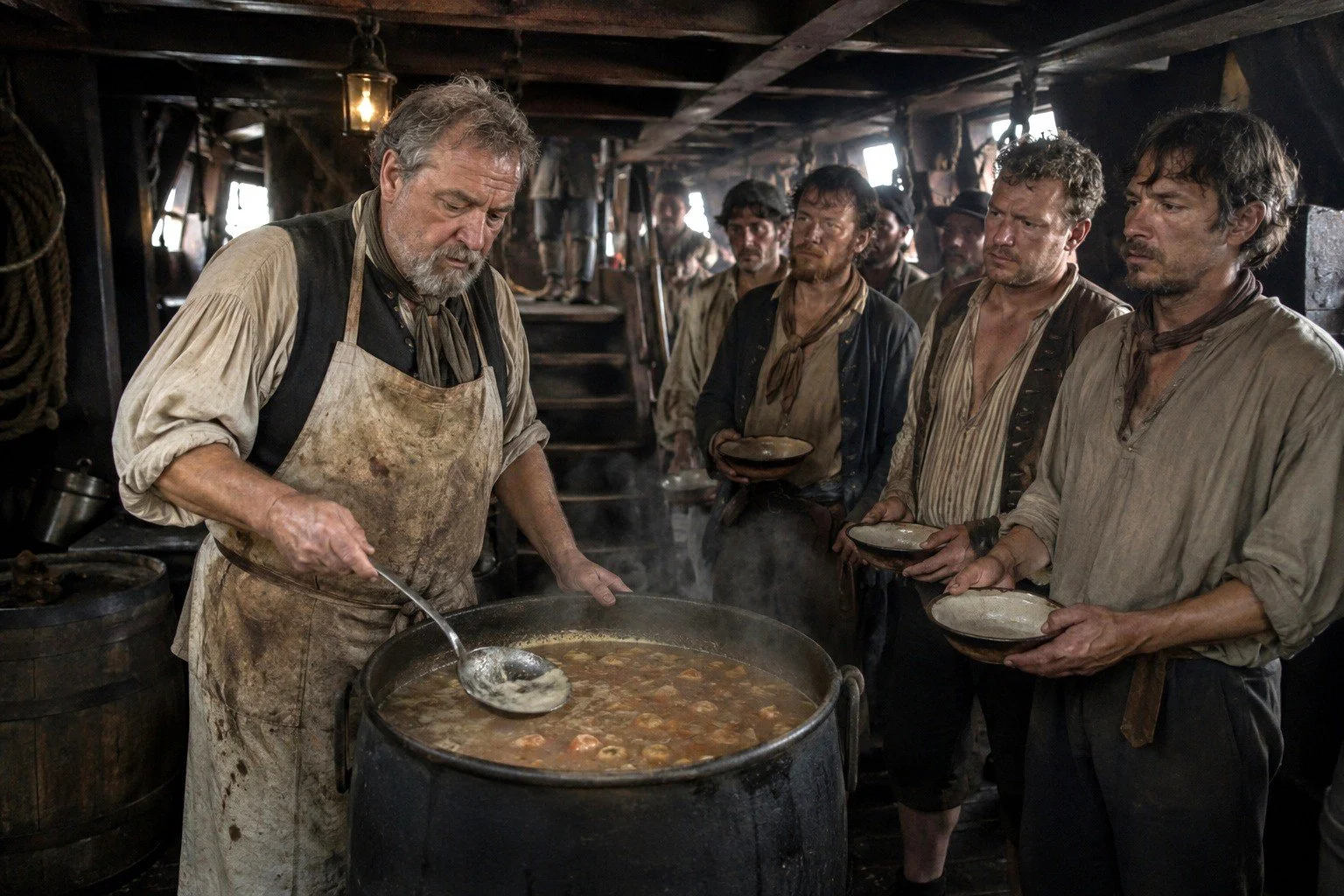
A cook on an 18th century sailing vessel skims the fat off his stew as he prepares to feed crew members. (Art: AI for TPP/ChatGPT)
May 26, 2026 by David Silverberg, candidate for Florida Senate District 28
When President Donald Trump reached a deal with his private attorney/acting Attorney General, Todd Blanche for a $1.776 billion payout for himself and anyone else he felt like paying, critics—and most of the public—immediately characterized it as a “slush fund.”
That started me wondering: why do we call it a “slush fund?”
I did some research and I thought the answer was so interesting that I would share it with you.
My name is David Silverberg and I’m a candidate for Florida state Senate in District 28, which covers Collier, Hendry and eastern Lee County.
According to the Merriam Webster dictionary, in the 1700s, the word “slush” meant “refuse grease and fat from cooking especially on shipboard”—the kind of leftover renderings that are caught in restaurant grease traps today.
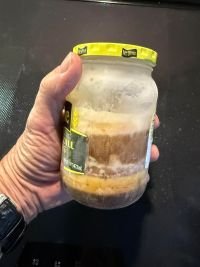
What slush looks like. In our house we pour cooking fat and grease into a jar that we keep in the freezer until it’s full. Then we toss it in the trash rather than pour it down the drain where it could clog the pipes. (Photo: Author)
In those days shipboard cooks would take the slush from their cooking and store it in barrels or other containers. But that waste didn’t go to waste. When the ship reached port the cooks would sell it to people like candle makers or soap makers or other businesses who had use for it. With the money they earned, the cooks (or whoever was overseeing the transaction), would buy goods for the crew, mostly personal items like musical instruments or books. This money belonged to the entire crew and it was called the “slush fund.”
The Merriam Webster online entry has some examples of this kind of activity. In particular:
In the course of a year, on board one of our large frigates, some fifteen or twenty barrels of slush is taken from the cooking apparatus, and sold for the purpose of creating the “slush fund.”
— Daily National Intelligencer (Washington, DC), 1 Apr. 1852
That’s a lot of slush! And it obviously resulted in a lot of cash.
The polite Commissary informed us that they received twelve dollars a barrel for the grounds, and thus added materially to the “Slush Fund.”
— Fort Wayne Gazette (Fort Wayne, IN), 12 May 1864
Up until the middle of the 1800s the term “slush fund” continued to mean just a general-purpose pot of money.
However, as might be imagined, slush funds weren’t always honestly or fairly managed and in the late 1860s it began to take on the connotation of corruption and illegality. From there it was a short step for it to be used in a political sense, usually meaning the source of bribes and corruption.
After referring to the evidence that a “slush fund” of $10,000 had been raised by the “ring” for use where it could be made available in furthering their scheme—in bribing officials?—this report says: We now approach an individual, to whose conduct in these transactions the attention of the public has been chiefly directed.
— The Selma Weekly Messenger (Selma, AL), 30 Mar. 1867
The meaning of “slush fund” hasn’t changed since then and today it has a firmly political connotation.
Make no mistake: Donald Trump’s $1.8 billion “anti-weaponization” fund is a “slush fund” in the fullest sense of the term.
In fact, it may be recorded as the most outrageously blatant, undisguised act of public corruption in American history. The fact that the term derives from grease, fat and waste is particularly appropriate in this case.
One can only imagine that Todd Blanche as a lawyer must be fully aware of this but he is so subservient and so corrupted himself that he would never push back. (Interestingly, according to author Michael Wolff, writing in his account of the 2024 election, All or Nothing, Trump despises Blanche for lacking the cleverness of his legal idol, Roy Cohen, or the courtroom panache of the fictional Perry Mason. Clearly, Trump keeps him on because he’s a useful tool. Anyone want to take bets on how long he lasts before he’s thrown under the bus?)
Narrowing our focus to Florida, it’s interesting that not a single sitting Republican official from the governor on down, including both senators and all state legislators, have spoken out or condemned this gargantuan criminal act. Obviously, the powers that be—what I call “Big Tallahassee”—is fine with it.
Indeed, Rep. Byron Donalds (R-19-Fla.), running for the Republican nomination as governor, has defended Trump’s slush fund as a magnanimous gesture: “Instead of taking the money, they said ‘put it into a fund for other people,’ and now everybody is losing their minds. I don’t understand that,” he said in an interview on Fox News on Sunday, May 24.
We could explain the problem with this thinking but it would be too time-consuming. Donalds might want to take note that the money will be going to the Jan. 6, 2021 rioters whom Donalds characterized at the time as “lawless vigilantes” who “wreaked havoc on the United States Capitol Building,” an “unruly mob” showing “a warped display of so-called patriotism” and “thuggery” and “a bunch of lunatics.” He praised the Capitol Police as “heroes for their dedicated efforts in dealing with this monumental task” and said he was “eternally grateful” for their efforts to protect him. These are now the same people suing to stop the slush fund from paying the people who attacked them.
At the state level, Florida has its own slush funds. One that came to light last year had to do with Hope Florida, a charity initiated and administered by Casey DeSantis, wife of Gov. Ron DeSantis (R). Hope Florida received $10 million from a $67 million Medicaid overbilling settlement. The money then took a circuitous route to political action committees fighting constitutional amendments that would have legalized abortion and recreational marijuana.
At the time the scandal broke last year, Casey DeSantis was a credible possibility to succeed her husband as governor.
The Florida House of Representatives launched an investigation, which was led by Florida House Rep. Alex Andrade (R-2-Pensacola) and his efforts implicated state Attorney General James Uthmeier for directing the funds or applications for funds—to groups headed by Uthmeier himself. Andrade accused Uthmeier of money laundering and wire fraud.
“This is a misuse of Medicaid dollars, a misuse of taxpayer dollars, I believe it’s money laundering and wire fraud,” Andrade said in an interview.
Uthmeier refused to cooperate with the investigation and retaliated by calling for Andrade to be ousted from his chairmanship of the House Health Care Budget Subcommittee, allegedly because of ties to Planned Parenthood.
It was an improper intrusion of an executive branch official into legislative prerogatives but characteristic of the kind of tactics that the DeSantis/Trump administrations have visited upon all restraints, checks or balances of executive power.
And then—poof!—the investigation went away. Andrade introduced a bill in the Florida House that made reforms to prevent this kind of abuse in the future. It passed unanimously there but died in the Senate. Andrade is term-limited and so will be unable to pursue his reforms any further.
Call me old-fashioned but I believe that the legislative branch needs to oversee the executive branch. I believe that crimes that are brought to light ought to be prosecuted. I believe that if non-profits or Cabinet officials are subpoenaed by legislative bodies they ought to be forced to respond, tell the truth and pay a penalty if they don’t comply. I believe that investigations should be pursued whether their subjects cooperate or not. I believe that elected representatives and senators in Florida should safeguard the money that taxpayers provide the state and see that it isn’t illicitly poured into private pockets.
Most of all, I believe that there shouldn’t be any criminal slush funds in Florida.
I intend to pursue these ends if I’m elected to the Florida Senate in District 28. More specifically, if elected I will also reintroduce the reforms that Andrade introduced. If voters overturn all the slush-slingers of Big Tallahassee this year, there might even be a chance that the reforms will become law.
I hope you agree. If you do, please donate, volunteer and most of all, vote for me in the general election. Early voting begins October 22. Election Day is November 3.
If you want to know more about my policy positions and background please visit my website, Silverberg4Florida.com, the campaign Facebook page or the The Paradise Progressive blog.
Together, let’s flush the slush from Florida.
See Silverberg4Florida.com for more positions and opportunities to volunteer.
To donate to the campaign, please click here.
To read other position papers:
Why I want to make Florida affordable again
Why I want to support our veterans
Why I want to protect our teachers and end the war on learning
Why I want to defend our Constitutions – both Florida’s and America’s
Why I want to protect Southwest Florida’s water
Why I want to keep Florida’s local governments strong
Why I want to end Alligator Alcatraz
Why I am running for the Florida State Senate in District 28
© 2026 by David Silverberg