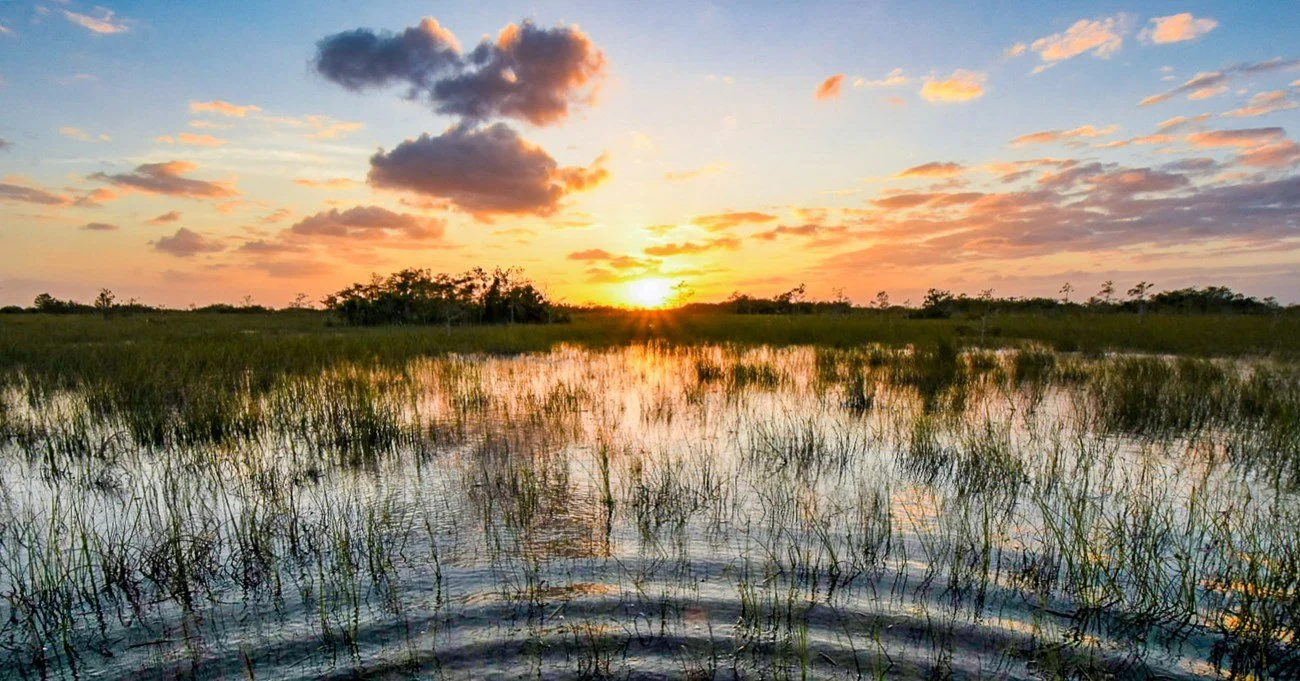
The Everglades. (Photo: National Park Service/Robert Krayer)
July 15, 2026 by David Silverberg, candidate for Florida Senate District 28
In August 2025, after a judge ruled that Alligator Alcatraz, the concentration camp in the Everglades, should be shut down, I gave some thought to what might be put in its place and made what I called “a modest proposal.”
Now comes word that not only has Alligator Alcatraz been officially shut down, the notorious sign announcing its presence has been removed.
I haven’t seen it myself, but if true it marks the end of a dark and disgusting chapter in Florida history.
The time has come to write the next chapter and I offer as a possibility the idea I put forward last year: an experiment that both restores the natural environment and honors William Mitsch, a respected academic, scientist, and wetlands warrior, who devoted his life and career to the health and purity of the wetlands that benefit us all.
I’m not sure how the future of the former Alligator Alcatraz site will play out. However, I can certainly pledge that if elected to the Florida Senate from District 28, which includes the site as well as all of Collier and Hendry counties and eastern Lee County, I will do my utmost to see that what replaces Alligator Alcatraz enhances the environment of Southwest Florida and the Everglades, as well as human knowledge and well-being.
Below is the proposal I first made in my blog, The Paradise Progressive on Aug. 24, 2025.
A modest proposal: Restoration and renewal

Bill Mitsch in his natural habitat, 2021. (Photo: Bill Mitsch)
William Jerome Mitsch was one of the world’s foremost scientific experts on wetlands like the Everglades and did much of his work at Florida Gulf Coast University. In 2022 he retired after a 47-year career and passed away in February of this year at the age of 77.
(To see a full profile of Mitsch and his work see: “On a personal note: An appreciation of Bill Mitsch, a wetlands warrior.”)
In 2018, Mitsch proposed a solution to the problem of pollution affecting the Everglades.
He called it “wetlaculture.”
The concept was that pollution could be defeated by creating new wetlands and this could be done by planting sawgrass, which is native and thrives in this area. The sawgrass would filter out contaminants while letting water flow. These new wetlands could be created on previously cultivated land. He believed that the grass would create soil so fertile that nitrate fertilizers would be unnecessary.
He calculated that new wetlands could be created over a 10-year time period. At the end of that time, the soil would be flipped and used for farming for 10 years. Then, it could be flipped again to lie fallow for another 10 years and so on, indefinitely.
A small-scale Wetlaculture experiment is already under way in Freedom Park in Naples, Fla. There, 28 bins hold sawgrass and researchers experiment with different levels of water and nutrients in the different bins as the sawgrass grows. Scientists measure nutrients in the soil and see if nitrates and phosphorous are being removed. When the soil is deemed to be clean and fertile enough they’ll plant crops and see how well they grow.
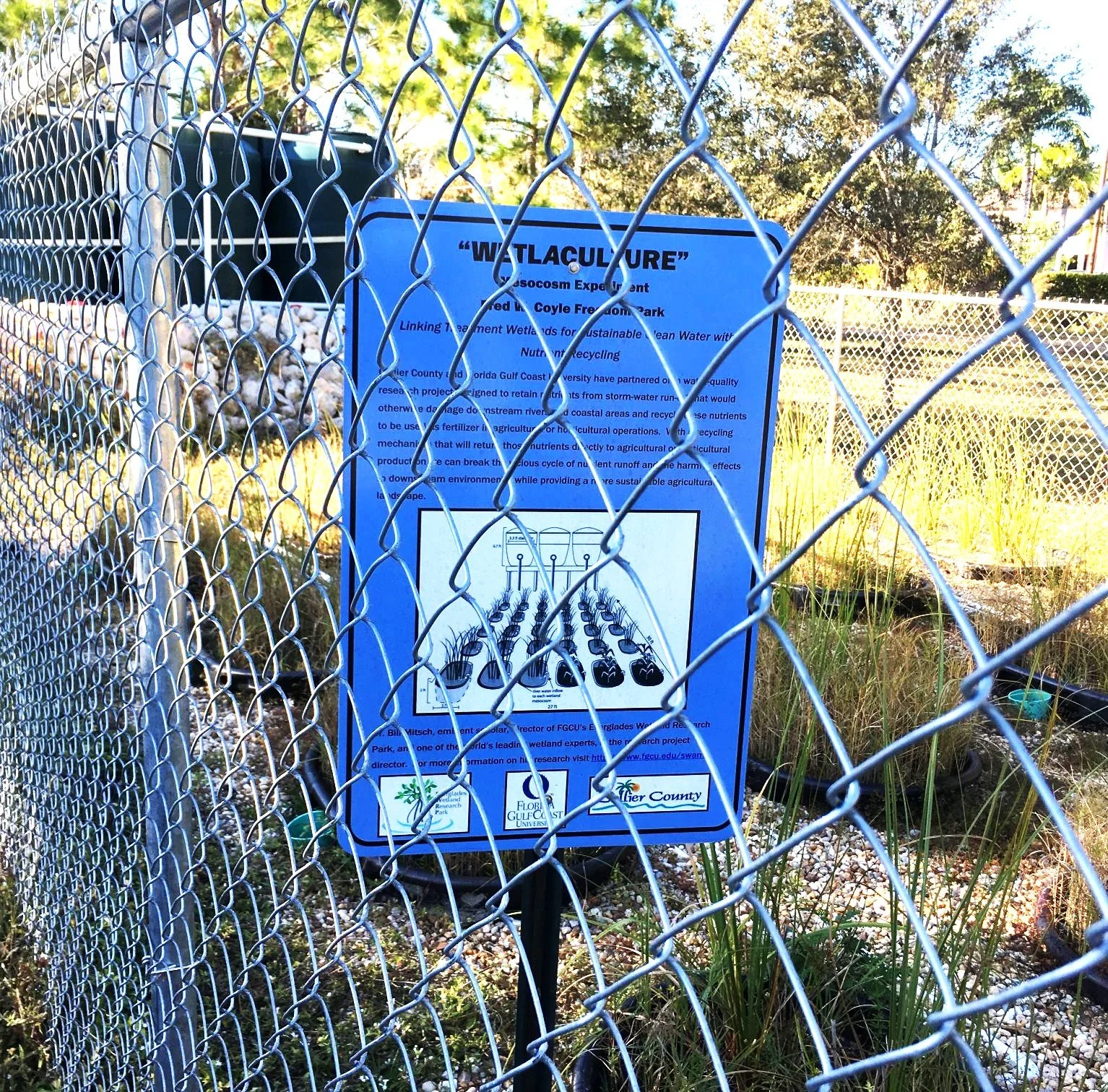
A sign marks the spot of the current Wetlaculture experiment in Freedom Park in Naples, Fla. (Photo: Author)
If Alligator Alcatraz is in fact closed and dismantled the “William J. Mitsch Memorial Wetlaculture Experiment and Everglades Restoration Project,” would be a most fitting replacement.
The concrete, asphalt and especially the runway could be scraped and removed and in its place be planted with sawgrass with an eye to flipping it after 10 years, or whenever scientists deem it appropriate. The plantings would likely restore water flow, cleanse pollution and prepare the soil for crops in their turn.
Instead of destroying the natural environment, the “William J. Mitsch Memorial Wetlaculture Experiment and Everglades Restoration Project” would restore it. Instead of the constant floodlights, the area would be restored to the darkness that made it part of Big Cypress’ International Dark Sky Park. Instead of noise and traffic, there would be quiet and calm. Instead of harming wildlife, animals could thrive. Instead of fencing out the public and the Miccosukee Indian Tribe, all would have access.
As for the expense, it would be far less than the $450 million expected to cost Florida taxpayers to run Alligator Alcatraz this year alone. It would also cost Florida and the nation far, far less to maintain in every subsequent year. Moreover, because it would be a scientific experiment, it would be eligible for academic and research funding.
Most of all, it would replace a concentration camp that is likely to be a blot and a stain on Florida’s history and on the history of the United States. Rather than a disgrace, Florida and the Everglades would have a site that improves the future, addresses environmental challenges and would be in harmony with the land, water, plants, animals, people and climate. Instead of punishment, the Mitsch Memorial Experiment would be a place of possibilities.
“When you come to a fork in the road, take it,” Yogi Berra, the Yankee baseball catcher famous for his malapropisms, supposedly said. Along the old Tamiami Trail, right on the Collier County-Dade County line, Florida and the American people have come to a fork in the road. One path leads to a concentration camp of deliberate human suffering, oppression and brutality. The other path leads to a restoration of nature’s balance, a hopeful future and great potential benefits.
The time has come to take the fork in the road. A “William J. Mitsch Memorial Wetlaculture Experiment and Everglades Restoration Project” is clearly the better path to follow.
This message approved and sponsored by the David Silverberg for Florida Senate Campaign.
See Silverberg4Florida.com for more positions and opportunities to volunteer.

To read other position papers:
Why I want to stop ‘tomatoflation’ – and end Big Tallahassee’s war on Florida’s workforce
Why I want to make Florida affordable again
Why I want to face hurricanes and climate change with confidence
Why I want to flush the slush from Florida
Why I want to support our veterans
Why I want to support professional policing and end terror in our communities
Why I want to protect our teachers and end the war on learning
Why I want to defend our Constitutions – both Florida’s and America’s
Why I want to protect Southwest Florida’s water
Why I want to keep Florida’s local governments strong
Why I want to end Alligator Alcatraz
Why I am running for the Florida State Senate in District 28
© 2026 by David Silverberg