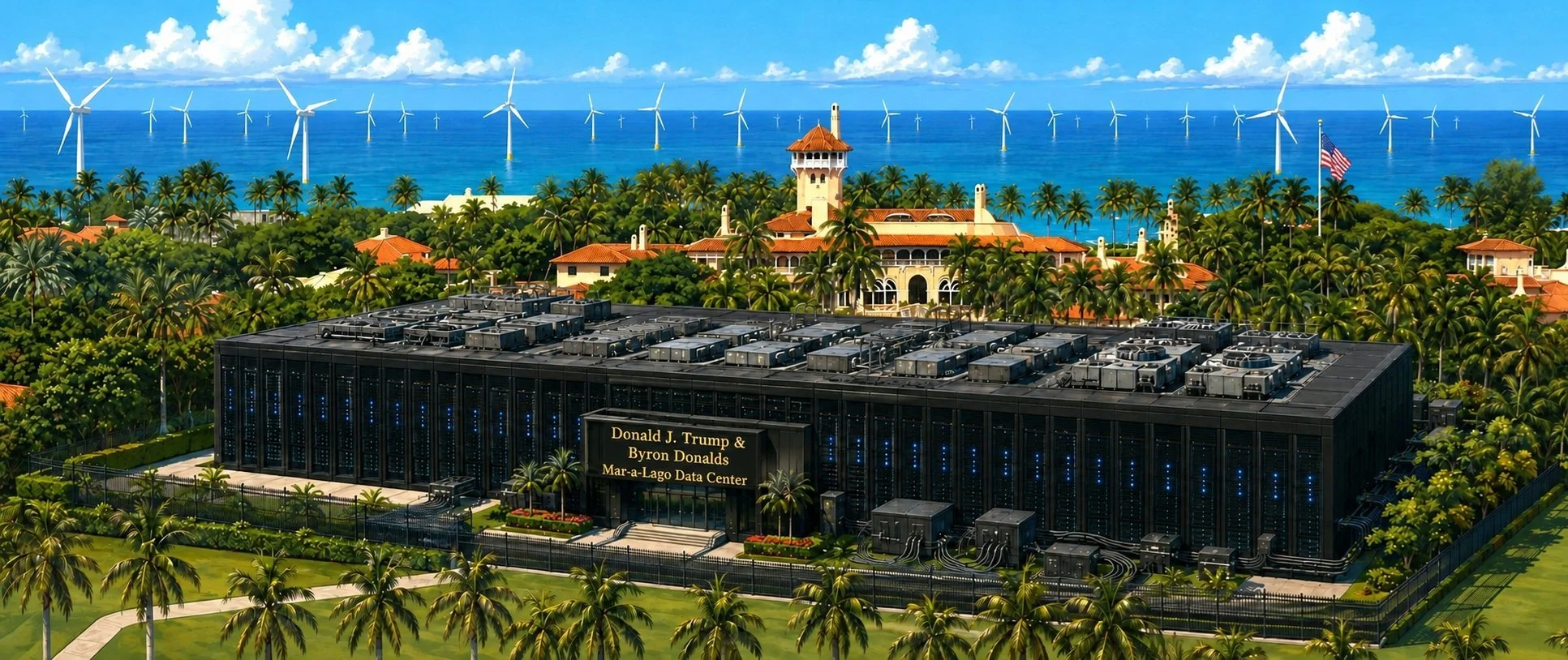
One can dream. (AI illustration for S4F/ChatGPT)
Aug. 24, 2026 by David Silverberg, candidate for Florida Senate District 28
I want to see the biggest, baddest, nastiest, noisiest data center in the world built right on the grounds of Mar-a-Lago here in Florida. Moreover, I want to see it powered by the world’s largest windfarm just offshore.
After all, President Donald Trump is all for data centers. As he said at the White House last week: “I’m only saying that if I ran a community—now there are different types of communities—but generally speaking, if I ran a community, if I was a mayor or if I was a governor in the state, I would want to have the data centers because they bring tremendous income.”
Well, he runs the community of Mar-a-Lago and he’s certainly greedy for income, so he should be fine with it.
What’s more, Republican gubernatorial candidate Rep. Byron Donalds (R-still allegedly representing the 19th Congressional District-Fla.) wants to see more data centers too.
“We are wide open, we have actual land in our state that is still pristine, available to use,” he said. “We can build out that stuff. I would rather build a data center in one of these deals, or probably four data centers.”
If they’re both so pro-data centers, then they should have no problem with a gargantuan cube on some open space right there on the grounds of Trump’s Florida home. Why would either of them object?
Now, I fully realize that the likelihood of a Mar-a-Lago data center is—shall we say—somewhat distant. (Although maybe it would be a better investment than a triumphal arch or a fake library!)
But for many Florida communities the possible presence of a data center is very real and in some cases quite immediate. People are upset and wary and they have every right to be. The very term “data center” conjures up visions of a water-wasting, power-gobbling, noisemaking monstrosity.
In fact, “data center” is not a great term because it covers such a wide variety of facilities and not all are equally harmful.
A “micro center” can be as small as a single server; a “modular” or “edge” center may take up a single room or floor of a building; an “enterprise” or “colocation” (or “colo”) center may serve a single company or be a modest building where different companies rent server space. Then there are “hyperscale” data centers—these are the gigantic facilities with tens of thousands of servers that suck up water and electricity. This is what people usually think of when they hear the term “data center.”
I’m running for office in Florida’s 28th Senate District, which covers all of Collier County, Hendry County and Lee County east of Rt. 75 as far north as Lee Blvd. It includes eastern Estero, RSW Airport and Gateway.
I did a search on Data Center Map, an industry standard, to see how many data centers are already in the District. It showed only one: the Digital Cloud Vault in Naples on Pelican Bay Blvd. It’s a micro center and doesn’t even sit in its own building.
To the best of my ability to determine, there are no hyperscalers in the works for District 28. If you elect me to the Florida Senate, I intend to keep it that way.
I’m not totally against all data centers. After all, I benefit from artificial intelligence (AI) just as much as anyone else. The illustration of the big, beautiful Mar-a-Lago hyper center that leads this posting was created by AI. (ChatGPT to be exact).
Many communities are imposing moratoriums on data center construction. This is a good thing. It provides a pause that gives local officials time to evaluate and analyze data center bids, local requirements and capabilities and the desirability of having the centers in their towns or counties.
David Jolly, Florida’s next governor, has taken a sensible stand, calling for a statewide moratorium.
He explained his position in an Instagram posting: “I propose a moratorium for three very specific reasons: first, the environmental protections are not in place where the data centers are rushing in before Florida has the appropriate regulations in place on water, on air, on, frankly, sound pollution, as well as for too many communities.”
He also argued that Florida wasn’t ready for the labor disruptions that data centers might bring and potential long-term damage to housing affordability as well as the potential privacy violations. “So I propose a moratorium for reasons of environmental protection, economic studies but also privacy and security.”
Jolly concluded: “When I see Byron Donalds say we need more data centers and actually kind of laugh about the environmental destruction, that’s not only a candidate out of touch with voters but that’s a candidate unfit to be governor.”
I completely agree with that.
If you elect me to the Florida Senate I will support Jolly’s efforts in that chamber.
But I would add that while a moratorium is a pause, it is not a passive thing; the pause it provides should be actively used to establish requirements, rules and regulations for future data center proposals.
Now, this may come as a shock to some people because I don’t usually agree with many of the decisions of the Board of Commissioners in my own Collier County—but in this case, Collier is handling the data center issue very sensibly.
Rather than impose a moratorium for a set period of time, Collier commissioners decided to use something called “zoning in progress,” which pauses center development while staff formulate regulations to govern any future data center proposals.
If they don’t want to establish moratoriums, other counties and towns might follow Collier’s example.
Either way, the headlong rush toward data center development needs to be paused.
I would add some thoughts to Jolly’s proposal. It appears to me that there need to be several basic requirements in evaluating data center projects and these guidelines can be set at the state level:
Water: Our water is so precious that there can’t be profligate use or pollution.
Electricity and use of renewables: Florida rate payers shouldn’t have to pay for data center electricity use and to the greatest extent possible, renewable forms of energy should be used.
Transparency: Anything related to data center proposals should take place in the full light of day.
Democracy: Residents must participate fully in any data center decisions. We can’t have Big Tallahassee impose its will without consent or consultation, the way it dumped Alligator Alcatraz on District 28.
We have a long way to go as we grapple with data centers in Florida and the artificial intelligence they power.
I intend to focus on these questions if elected to the Florida Senate in District 28. Anything affecting our lives, health and environment will be top priorities.
I hope you agree with these proposals and if you do, that you’ll vote for me for Florida Senate from District 28 in the general election on November 3.
This message is approved by David Silverberg and the David Silverberg4Florida campaign.
See Silverberg4Florida.com for more policy positions.

To read other position papers:
Why I will introduce the “We All Need A Heat Break Act”
Why I will introduce the ‘New Hope for Florida Act’
Why I want to stop ‘tomatoflation’ – and end Big Tallahassee’s war on Florida’s workforce
Why I want to make Florida affordable again
Why I want to face hurricanes and climate change with confidence
Why I want to flush the slush from Florida
Why I want to support our veterans
Why I want to support professional policing and end terror in our communities
Why I want to protect our teachers and end the war on learning
Why I want to defend our Constitutions – both Florida’s and America’s
Why I want to protect Southwest Florida’s water
Why I want to keep Florida’s local governments strong
Why I want to end Alligator Alcatraz
Why I am running for the Florida State Senate in District 28
© 2026 by David Silverberg